
Blog
The Hidden Costs of Workplace Injuries Most Employers Never Measure
October 15, 2026

When a workplace injury occurs, most employers focus on the obvious costs: medical treatment, lost time, and the workers’ compensation claim.
What many organizations fail to recognize is that workplace injuries often create a ripple effect throughout the business. Productivity slows, supervisors spend time managing the situation, coworkers take on additional responsibilities, and projects may fall behind schedule. In many cases, the indirect costs of an injury can exceed the claim itself.
The challenge is that these costs are harder to see. They do not show up neatly on an insurance report or monthly invoice. Instead, they appear over time through operational disruptions, staffing challenges, administrative burden, and increased business risk.
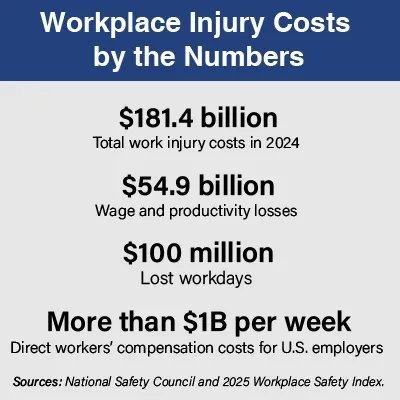
According to the National Safety Council’s most recently available work injury cost estimates, workplace injuries cost an estimated $181.4 billion in 2024, including $54.9 billion in wage and productivity losses alone.1
The impact is significant for employers as well. According to the 2025 Workplace Safety Index, disabling workplace injuries generate more than $1 billion per week in direct workers’ compensation costs for U.S. employers.2,3
For business leaders, the important question is not simply:
“What did the claim cost?”
It is:
“What did this injury cost the entire organization?”
The Claim Is Only the Most Visible Cost
Workers’ compensation claims provide a measurable record of medical expenses and lost wages. They do not necessarily capture every operational and financial consequence.
The Occupational Safety and Health Administration identifies training replacement employees, investigating incidents, implementing corrective actions, repairing damaged equipment, lost productivity, lower morale, and absenteeism as examples of indirect workplace injury costs.3
Overtime may appear under payroll. Temporary coverage and schedule adjustments may affect operations. Lost productivity may be spread across multiple departments. Supervisors may spend hours coordinating coverage, managing restrictions, and supporting return-to-work efforts. Because these costs appear in different places, leadership may never see the full financial impact of a single injury.
Lost Productivity Can Extend Beyond the Injured Employee
When an employee is injured, the impact often extends well beyond their individual role.
Work still needs to be completed, customer commitments still need to be met, and teams must continue operating while adjusting to the absence. Supervisors may need to reassign responsibilities, shift priorities, or redistribute workloads to keep operations moving.
The disruption can be especially significant when the employee performs specialized work or plays a critical role within a smaller team.
The National Safety Council estimates that work-related injuries accounted for 102 million lost days in 2024, including both current-year injuries and the continued impact of injuries from previous years.1
For business owners, this highlights an important reality: workplace injuries are not simply an employee issue. They affect workforce capacity and an organization’s ability to maintain consistent performance.
Overtime and Replacement Labor Put Pressure on Margins
As workforce capacity decreases, labor costs often begin to increase.
To maintain service levels, employers may rely on overtime, temporary staffing, cross-training, or workload redistribution. While these adjustments help keep operations running, they often come at a higher cost and may reduce efficiency as employees take on unfamiliar responsibilities.
Temporary workers may also face a steeper learning curve as they become familiar with the work environment, safety expectations, equipment, processes, and responsibilities associated with the role. Likewise, employees covering for absent coworkers often take on additional duties beyond their normal responsibilities. Both situations can increase the likelihood of errors, safety concerns, and workplace incidents if workloads, training, or expectations are not managed carefully.
Additional demands are frequently placed on supervisors and experienced team members who must coordinate coverage, answer questions, and support operational continuity.
These expenses rarely appear alongside workers’ compensation claims, making them easy to overlook when evaluating the true financial impact of an injury.
Management Time Is a Real Business Expense
Workplace injuries also require significant attention from supervisors, HR teams, safety professionals, and senior leaders.
They may need to:
- Document and investigate what happened
- Communicate with the employee
- Coordinate with the carrier and medical providers
- Adjust schedules and job responsibilities
- Monitor work restrictions
- Develop transitional work
- Respond to employee or management questions
- Track reporting and compliance requirements
Each task serves an important purpose. Together, however, they can pull leadership attention away from customers, employees, strategic priorities, and business growth.
This is one of the most commonly overlooked costs because management time is rarely assigned a dollar value after an incident.
Workplace Injuries Can Affect the Rest of the Team
An injury can change how employees feel about their workplace.
Coworkers may wonder whether the incident could have happened to them. They may become frustrated by increased workloads or uncertain about whether safety concerns have been addressed. If communication is inconsistent, employees may create their own explanations for what happened and how the organization is responding.
Morale is difficult to measure, but its effects can appear through absenteeism, reduced engagement, productivity challenges, and turnover. The Occupational Safety and Health Administration specifically identifies lower employee morale and absenteeism among the indirect costs associated with workplace injuries and illnesses.3
The way an organization responds can therefore affect more than the injured employee. It can influence workforce confidence in leadership, safety, and the organization’s commitment to its people.
One Injury Can Have a Larger Impact on Profitability Than Employers Realize
Most employers think about workplace injuries in terms of the direct costs associated with a claim. What is often missed is how quickly those costs expand when lost productivity, higher labor costs, operational disruption, management time, and delayed projects are added to the equation.
A workplace injury is not simply a workers’ compensation event. It is a business interruption event.
Even an injury with relatively modest claim costs can create a much larger financial impact when it affects production schedules, customer commitments, staffing levels, or the productivity of other employees.
This is why leading organizations look beyond claims costs alone. They focus on identifying risk factors, addressing operational gaps, and reducing disruptions before they become larger business problems.
The Greatest Risk May Be What the Injury Reveals
A workplace injury can expose weaknesses that existed before the incident.
Those weaknesses may include:
- Delayed incident reporting
- Incomplete documentation
- Inconsistent supervisor training
- Outdated job descriptions
- Incorrect employee classifications
- Limited safety follow-up
- Poor coordination with carriers or medical providers
- No clear return-to-work process
Administrative gaps often affect more than workers’ compensation. They can create challenges across HR, payroll, benefits administration, compliance, and employee communication. Read our related article on Preventing Costly Mistakes: Where HR, Benefits, and Workers’ Comp Often Go Wrong.
That is why the cost of an injury should not be evaluated only by looking at the claim. Leaders should also consider what the incident reveals about the organization’s people, processes, communication, and ability to manage risk.
A Different Approach to Workers’ Compensation and Safety
At Ataraxis, we do more than provide workers’ compensation coverage or file claims. We take an active, hands-on approach that connects claims management, workplace safety, risk analysis, early medical coordination, and return-to-work planning.
Our team supports the process from the initial claim triage and carrier filing through ongoing oversight and communication. We also provide clients with visibility into claim status, costs, and outcomes while helping identify workplace risks and opportunities for improvement.
This connected approach benefits our clients by reducing the burden when injuries occur, helping avoid unnecessary delays, supporting safer return-to-work transitions, and giving leadership clearer insight into the factors influencing risk and cost. The goal is not simply to respond to claims. It is to help clients manage workers’ compensation and safety more proactively, with experienced professionals actively involved throughout the process.
See More Than the Claim
Most of the costs associated with workplace injuries never appear on an insurance statement. They show up in productivity, staffing, overtime, management time, employee morale, and operational disruption.
Ataraxis helps employers identify hidden risks, improve visibility into workers’ compensation and safety performance, and create a more proactive approach to risk management. Through hands-on claims oversight, safety support, risk analysis, and return-to-work coordination, we help clients reduce unnecessary disruption and improve outcomes for both their people and their business.
If you’re wondering what workplace injuries may really be costing your organization, let’s start a conversation.
Sources
- National Safety Council: Work Injury Costs
- Liberty Mutual: 2025 Workplace Safety Index
- OSHA Business Case for Safety and Health
Frequently Asked Questions
What are the hidden costs of a workplace injury?
Hidden costs may include lost productivity, overtime, replacement labor, investigation time, administrative work, training, equipment damage, lower morale, and absenteeism. OSHA
How do workplace injuries affect business profitability?
In addition to direct claim expenses, employers may absorb indirect costs and need additional sales to offset the effect on profitability. OSHA’s Safety Pays estimator illustrates this relationship using direct costs, indirect costs, and the employer’s profit margin.
Do workers’ compensation claims show the full cost of an injury?
Not necessarily. Claims typically provide visibility into insured or direct expenses, while operational effects such as lost productivity, management time, staffing disruption, and morale may appear elsewhere in the business.
How can employers reduce the business impact of workplace injuries?
Employers can take a more proactive approach through safety assessments, timely reporting, accurate documentation, active claim oversight, and safe return-to-work planning. Ataraxis incorporates these elements into its workers’ compensation and safety support.